
Wallet Mirroring
Executive Summary
This section describes a generic integration pattern for master–master wallet mirroring between a Fintech platform and a Regulated Financial Institution (RFI) operating a Banking‑as‑a‑Service (BaaS) platform.
The pattern enables a 1:1 wallet mapping between systems where:
- The Fintech wallet platform remains the system of record (SoR) for customer wallet state and all customer‑initiated transactions.
- The RFI BaaS platform executes regulated banking operations, enforcing limits, compliance, and fraud controls.
- Transactions follow a single canonical flow initiated by the Fintech platform, ensuring operational consistency and reconciliation integrity.
- Bank‑originated events are converted into canonical flows by notifying the Fintech platform to initiate the transaction.
This architecture ensures:
- Regulatory compliance
- Transaction idempotency
- Operational resilience
- Consistent reconciliation between the two ledgers
Background and Objectives
Many fintech wallet platforms require integration with regulated banking infrastructure to perform actions such as:
- Deposits
- Withdrawals
- Transfers
- Compliance checks
- Fraud evaluation
However, fintech platforms often maintain their own wallet ledgers and customer workflows.
This pattern enables a master–master synchronization model where:
| System | Responsibility |
|---|---|
| Fintech Platform | Customer wallet ledger, transaction orchestration |
| Regulated Financial Institution | Banking execution, regulatory enforcement |
Objectives
- Enable 1:1 wallet mirroring
- Maintain Fintech‑initiated canonical transaction flows
- Ensure idempotency and ordering
- Support fraud and compliance checks
- Provide reconciliation and auditability
Stakeholders and Roles
| Party | Role | Responsibilities |
|---|---|---|
| Fintech Platform | Wallet System of Record | Initiates transactions, maintains wallet balances, handles rollbacks |
| BaaS Platform | Banking Execution Layer | Executes financial operations and maintains mirrored wallets |
| Regulated Financial Institution | Regulatory Authority | Owns bank accounts, policies, and compliance obligations |
| Fraud Platform | Fraud Detection | Evaluates transactions and provides approval/decline signals |
High Level Architecture
The integration uses bidirectional APIs with strict control over transaction initiation.
Key principle:
All transactional flows originate from the Fintech platform.
Components
-
Fintech Wallet Platform
- Customer wallet ledger
- Transaction orchestration
-
BaaS API Gateway
- mTLS termination
- JWT validation
- Request signature validation
- Rate limiting
- Idempotency protection
-
Transaction Orchestrator
- Executes financial transactions
- Applies policy and limits
- Invokes fraud checks
-
Event Notification Service
- Sends notifications to the Fintech platform when bank events occur
-
Reconciliation Engine
- Performs ledger matching and dispute analysis
Wallet Creation and Master–Master Synchronisation
A 1:1 mapping exists between:
- Fintech wallet IDs
- BaaS wallet IDs
The mapping is maintained by both systems.
Identity Requirements
Each wallet must include:
- External Wallet ID (Fintech identifier)
- Internal Wallet ID (BaaS identifier)
- Wallet status
- Customer KYC attributes
Wallet lifecycle events include:
- Create
- Suspend
- Block
- Close
Wallet status changes must be synchronized between both systems.
Ledger Model
The system uses double‑entry accounting.
Every transaction results in:
- One debit
- One credit
Example:
Customer pays a fee:
Debit: Customer Wallet
Credit: Fee Wallet
Additional wallet types may include:
- Customer wallets
- Fintech operational wallets
- Settlement wallets
- System wallets
System wallets represent money entering or leaving the regulated banking environment.
Canonical Transaction Pattern
All wallet transactions follow this pattern:
Fintech → BaaS → Banking System → Response → FintechThis ensures:
- One orchestration path
- Consistent auditing
- Simpler reconciliation
Transaction Flows
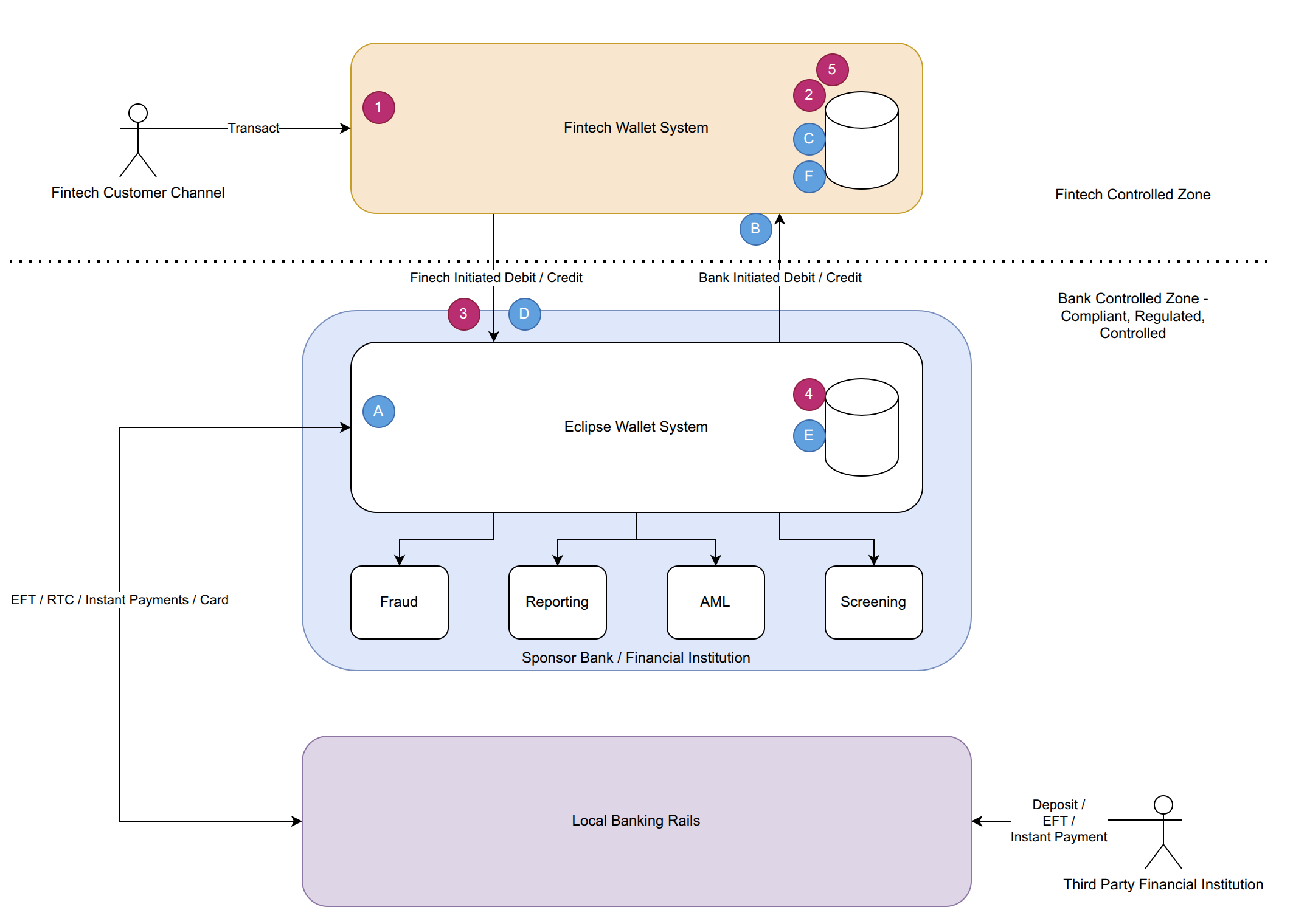
Fintech Initiated Transaction
- Fintech wallet receives a transaction request from its channels
- Fintech wallet does all internal processing but does not commit its transaction
- Eclipse is asked to also do the transaction.
- Eclipse does Fraud, screening etc and limit checks and updates its ledger and responds
- Fintech commits its ledger transaction
Eclipse/Bank Initiated Transaction
A. Eclipse wallet receives a transaction request from its bank integrations
B. Eclipse delegates the transaction to the Fintech
C. Fintech wallet does all internal processing but does not commit its transaction
D. Eclipse is asked to also do the transaction.
E. Eclipse does Fraud, screening etc and limit checks and updates its ledger and responds
F. Fintech commits its ledger transaction
Peer‑to‑Peer Transfers
Internal wallet transfers follow the same canonical model.
Idempotency and Ordering
Each transaction includes a globally unique idempotency key.
Properties:
- Prevents duplicate execution
- Supports safe retries
- Enables distributed consistency
The BaaS platform must:
- Reject duplicate keys
- Return previous result for replays
Limits, Risk and Fraud
Transactions are evaluated by:
- Bank policy rules
- Transaction limits
- Fraud detection engines
Possible decisions:
- Approve
- Decline
- Review
Declines must include clear reason codes so the Fintech platform can reverse provisional wallet operations.
Error Handling and Reversals
Errors fall into several categories:
- Validation errors
- Policy violations
- Fraud declines
- Processing errors
- Transient failures
If a transaction fails after a provisional wallet change, the Fintech platform must reverse the transaction locally.
Atomic batch transfers should support full reversal by session ID.
Security and Compliance
Security controls include:
- Mutual TLS authentication
- JWT authentication
- Request signature validation
- Replay protection
- Full audit logging
Recommended standards:
- TLS 1.2+
- HMAC request signatures
- Rotating API credentials
Reconciliation
Reconciliation is performed daily between both systems.
Typical reports include:
Balance Report
Total balance grouped by wallet type.
Transaction Report
Includes:
- Source wallet ID
- Destination wallet ID
- Idempotency key
- Amount
- Timestamp
Customer Report
Includes:
- Customer identifier
- Wallet IDs
- Status
- Creation timestamp
These reports ensure ledger integrity across platforms.
Monitoring and Observability
Operational visibility should include:
- Transaction latency metrics
- Fraud decision telemetry
- Error rate monitoring
- API call tracing
- Idempotency conflict monitoring
Distributed tracing is recommended for debugging cross‑platform transactions.
Key Design Principles
- Fintech initiates all flows
- Bank events trigger canonical flows
- Wallets are mirrored but independent
- Strict idempotency guarantees
- Double entry accounting
- Reconciliation is mandatory
- Security by default
Benefits of the Pattern
This architecture provides:
- Regulatory separation
- Operational clarity
- Simplified reconciliation
- Safe distributed transactions
- Fraud and compliance enforcement
- Scalable wallet infrastructure
Updated 5 months ago