
Introduction
Audience and Scope
This document is intended for third-party product owners, architects, and developers who plan to integrate with Eclipse as an open, feature-rich digital wallet and card issuing platform. Eclipse exposes a comprehensive catalogue of APIs that enable tenants to manage the full lifecycle of an Eclipse customer, from onboarding and authentication through to wallet creation, card issuing, top-ups, transfers, withdrawals, and related activities.
All examples in this guide reference the Eclipse Sandbox environment. The sandbox is publicly accessible and allows teams to begin integrating with the Eclipse APIs for proof-of-concepts, demonstrations, and functional testing before moving to production.
Full API Reference: Every Eclipse endpoint is documented at developer.eftcorp.com/reference. Use it alongside this guide to explore request/response schemas, required fields, and error codes for any operation.
About Eclipse
About Eclipse
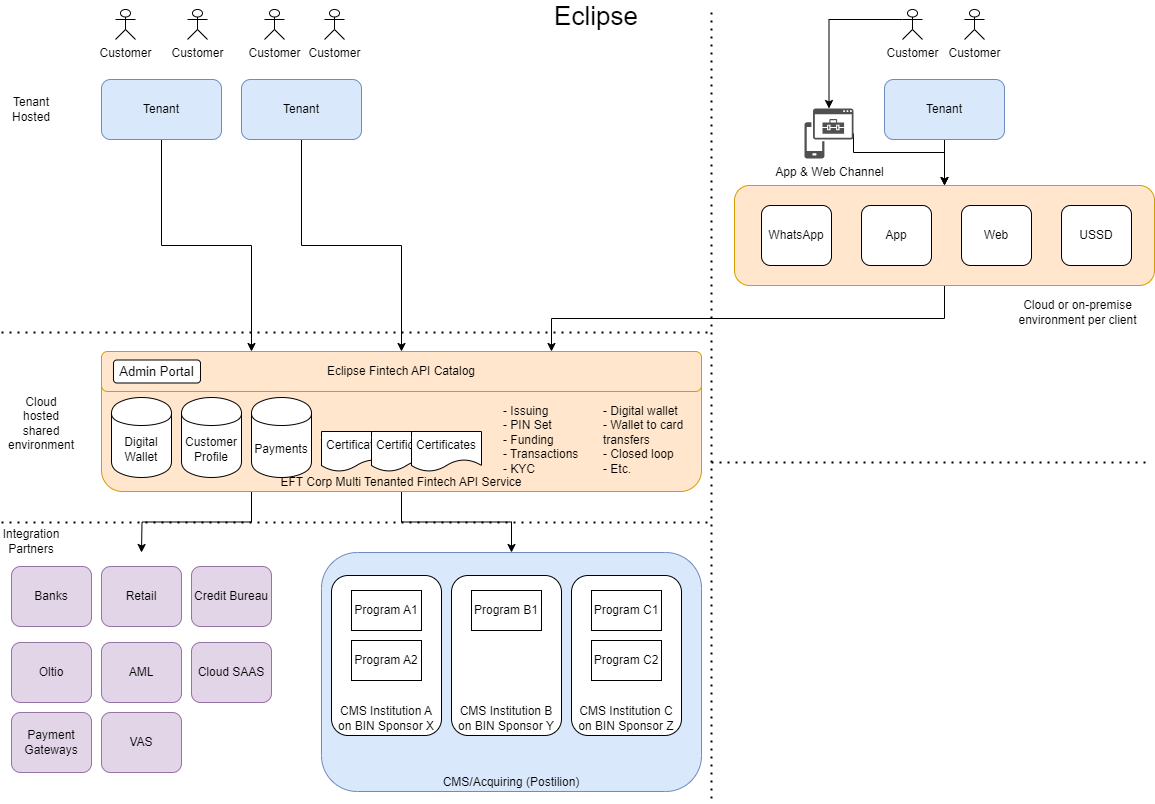
Eclipse is a multi-tenant, cloud-native, API-first platform with an associated administrative console that enables banks, fintechs, and telecom operators to build flexible and compelling financial services propositions across global markets. Eclipse is built and operated by EFT Corporation and is not associated in any way with the Eclipse Foundation or the Eclipse IDE. The similarity in naming is purely coincidental.
Built on hundreds of man-years of experience across financial services, payments, and telecommunications, Eclipse is designed to remove much of the complexity traditionally associated with building and operating regulated financial products. Rather than acting as a monolithic core, Eclipse provides a set of modular services that can be consumed independently and composed to support a wide range of business models and use cases.
Platform Overview
Eclipse provides the foundational building blocks required to design, launch, and operate modern financial products. These capabilities are exposed through well-defined APIs and supported by an administrative console for configuration, operations, and support.
At a high level, Eclipse covers:
Core Banking and Account Services
- Customer and organisation management
- Account, wallet, and balance management
- Ledgering and transaction posting
- Product configuration, fees, limits, and controls
- Transaction history and reporting
Payments and Money Movement
- Payment gateway services
- Domestic and cross-border payment integrations
- Bank and scheme integrations
- Real-time transaction processing and status updates
- Support for multiple payment rails and payout mechanisms
Cards and Acceptance
- Card issuing and lifecycle management
- Physical and virtual card support
- Card acceptance and merchant-related capabilities
- Real-time authorisation and transaction events
- Integration into EFT’s switching and processing infrastructure
Digital Channels and Integration
- API-first design for mobile, web, and embedded finance use cases
- Clear separation between backend services and customer-facing channels
- Event-driven patterns for notifications and state changes
- Support for partner and third-party integrations
Compliance, Risk, and Security
- Authentication and access control
- KYC and onboarding workflows
- Transaction limits, blocks, and risk controls
- Auditability and traceability across platform actions
- Integration points for external compliance and risk services
Cloud-Native Operations
- Designed for cloud deployment and horizontal scaling
- High availability and resilience built into the platform
- Support for modern SDLC practices, including CI/CD and automated testing
- Incremental rollout of new capabilities without disruptive releases
AI-Native development
- Eclipse is designed to work seamlessly with AI-assisted development tools.
- A built-in Model Context Protocol (MCP) server allows AI tools to interact directly with Eclipse APIs and documentation.
- This enables code generation, API discovery, and integration guidance using real platform context.
- MCP provides controlled access to documentation, supported operations, and live account data where applicable.
- Learn more about Eclipse MCP support here.
What Differentiates Eclipse
Eclipse is designed to separate the payments and card “engine room” from the end-user proposition. This allows product and engineering teams to focus on differentiation, customer experience, and speed to market, while relying on a proven platform to handle scale, security, compliance, and complex partner integrations.
Building products involving digital wallets, card issuing or acceptance, and payment processing typically requires navigating significant technical and regulatory hurdles. Eclipse addresses these challenges by providing production-grade building blocks that can be composed and extended to support a wide range of propositions.
Whether delivering a digital wallet, corporate card programme, rewards platform, marketplace, or an embedded finance experience delivered through partner or messaging channels, Eclipse provides a robust foundation on which to build and evolve financial services with confidence.
Updated 4 months ago